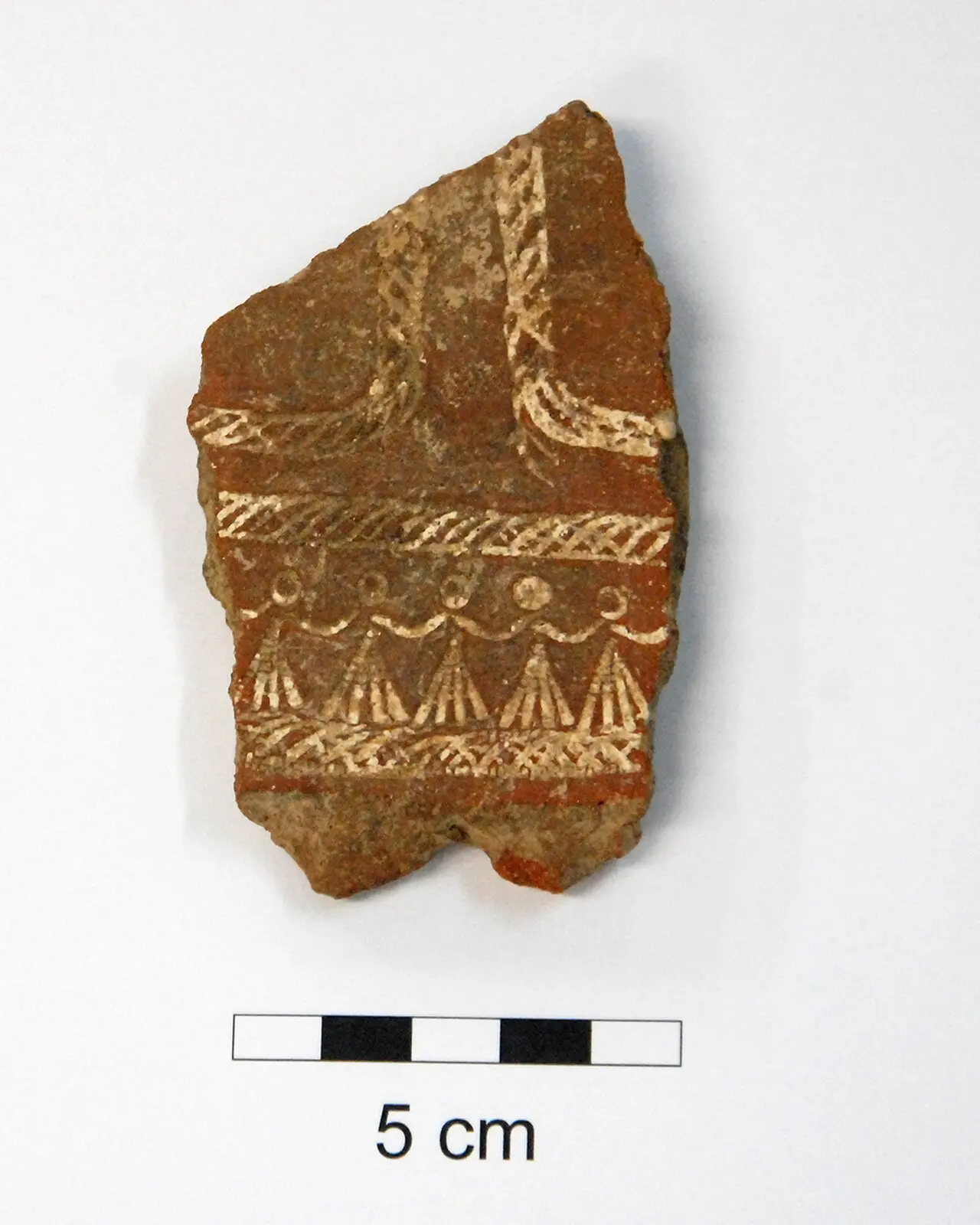
c. 1000 BCE · Voyagers settle Fiji
Lapita-associated voyagers establish communities in Fiji around 3,000 years ago. Archaeologists study pottery and dated material to investigate these early settlements.
About this date
“c.” means approximately; BCE means before the Common Era. An exact first-arrival year is not established. Later population movements were complex: current research identifies multiple dispersals, so a single “first Melanesian arrival” in 1000–500 BCE would be misleading.
The Lapita people (28 pictures) · Fijian pottery through time (10 pictures)
Explore the related picture — Object photograph, 2008. The excavated potsherd is from Bourewa, Fiji; the photograph date is separate from the settlement date.
Browse historical books on Fiji — Wider background from books published through 1930. For Lapita dating, follow the archaeological sources for this milestone.
Sources for this moment
1643 · Tasman records northeastern Fiji
Abel Tasman sails through northeastern Fiji during his Pacific voyage, adding these islands to European navigational records.
Abel Tasman sights Fiji, 1643 (10 pictures)
Explore the related picture — Historical map from the museum’s Tasman chapter. It records a wider voyage context; it is not a photograph of the 1643 encounter.
Explore A History of Fiji — A 1915 historical account for wider reading, distinct from Tasman’s voyage record.
Sources for this moment
1774 · Cook’s voyage records Vatoa
James Cook names Vatoa “Turtle Island”. A surviving chart from the voyage identifies the island in July 1774.
James Cook at Vatoa, 1774 (11 pictures)
Explore the related picture — A modern photograph of a book at Canterbury Museum, taken in 2016. The Vatoa entry is supported by the 1774 chart linked in its sources.
Explore A History of Fiji — A later historical account for wider context. The dated Vatoa chart remains the evidence for this milestone.
Sources for this moment
1804 · The sandalwood trade begins
Commercial sandalwood voyages begin, drawing overseas merchants to Fiji, especially Vanua Levu.
The sandalwood rush (10 pictures) · Forests and the land (11 pictures)
Explore the related picture — Botanical photograph, 2017: Pacific sandalwood. It shows the plant, rather than a reconstructed trading scene.
Read Samuel Patterson’s account — An 1817 Pacific travel account that includes Fiji. Historical testimony carries the perspective and terminology of its author.
Sources for this moment
Early 1800s · Firearms reshape chiefly warfare
Imported firearms change the balance between rival chiefdoms and contribute to Bau’s growing influence. This develops across several leaders and decades.
War and warriors (13 pictures) · Bau and Cakobau (13 pictures)
Explore the related picture — Portrait made in Fiji in 1884. It introduces the warfare collection; it does not depict the early introduction of firearms.
Browse Fiji and the Fijians — Nineteenth-century accounts available in several scans and editions. Read their descriptions in their colonial and missionary context.
Sources for this moment
12 October 1835 · A Wesleyan mission at Lakeba
William Cross and David Cargill arrive with their families and Tongan companions to establish the Lakeba mission. Pacific Christian teachers had already reached Fiji.
Old gods and the missionaries (15 pictures) · Churches, schools and written Fijian (12 pictures)
Explore the related picture — A photograph of a missionary journal held at Derby Museum. The collection caption does not identify it as Cross’s or Cargill’s diary.
Explore mission books — Historical mission accounts and editions from the library; these are related reading, not a claim that each describes the 1835 arrival.
Sources for this moment
1853 · Cakobau seeks Tongan help
Facing opposition to Bau, Cakobau discusses assistance with King Tupou during a visit to Tonga. These talks do not yet produce a formal military alliance.
Bau and Cakobau (13 pictures) · Ma’afu and the Battle of Kaba (12 pictures)
Explore the related picture — A seated portrait from 1861, eight years after the talks. It is a related portrait, not a record of the meeting with Tupou.
Browse Fiji and the Fijians — Related nineteenth-century reading. The linked ANU scholarly source distinguishes the 1853 talks, 1854 conversion and 1855 battle.
Sources for this moment
30 April 1854 · Cakobau professes Christianity
Cakobau publicly declares his Christian faith at Bau. His conversion takes place amid conflict and political pressure.
About this date
This is the public profession of faith, rather than a baptism date. It belongs in 1854, separate from the 1853 discussions and the following year’s battle.
Bau and Cakobau (13 pictures) · Old gods and the missionaries (15 pictures)
Explore the related picture — Cakobau photographed about 1875. The portrait was made after his 1854 profession of faith.
Browse Fiji and the Fijians — Historical accounts from missionary and colonial perspectives; compare them with the event’s scholarly source.
Sources for this moment
1855 · Tongan support at Kaba
King Tupou and Tongan forces support Cakobau at the battle of Kaba, strengthening his position against opponents of Bau.
Ma’afu and the Battle of Kaba (12 pictures) · Bau and Cakobau (13 pictures)
Explore the related picture — Ma’afu with his family in an 1861 portrait. This is related material on Tongan influence in Fiji, not an image of King Tupou or the battle.
Browse Fiji and the Fijians — Related nineteenth-century accounts. Follow the linked ANU history for the battle and its political setting.
Sources for this moment
1871 · The Kingdom government is formed
A government is established with Cakobau as king and influential European settlers playing a prominent part. Its Legislative Assembly meets at Levuka.
The Kingdom of Fiji (10 pictures) · Levuka, the first capital (10 pictures)
Explore the related picture — Treasury note issued at Levuka on 14 February 1872. It is an object from the Kingdom period, one year after the government formed.
Read Fiji: its political aspect — A catalogued account of Fiji’s politics from 1870 to 1873, published in 1873 under the name Vindex.
Sources for this moment
10 October 1874 · Fiji is ceded to Britain
Cakobau and other high chiefs sign the Deed of Cession. Sir Hercules Robinson accepts the cession on behalf of Queen Victoria.
About this date
Queen Victoria was represented by Robinson; she did not personally sign the deed in Fiji.
The Deed of Cession (10 pictures) · The Kingdom of Fiji (10 pictures)
Explore the related picture — Studio portrait of Sir Hercules Robinson, dated 1872–1879 by the collection. It is not a photograph of the signing ceremony.
Read the colonial correspondence — Correspondence relating to Fiji, 1874–1877, attributed to Great Britain’s Parliament in the catalogue.
Sources for this moment
By 1875 · A colonial Legislative Council
The Legislative Council is already operating under British colonial government. A parliamentary record identifies legislation it passed in December 1875.
About this date
“By 1875” records evidence of the Council in operation, not a claimed exact founding date. Its origins predate 1953.
Governor Gordon and the new order (10 pictures) · The Deed of Cession (10 pictures)
Explore the related picture — Portrait of Arthur Hamilton-Gordon, captioned 1870. It introduces colonial government; it does not show a Council meeting.
Read the colonial correspondence — Government correspondence for 1874–1877. The separate Hansard citation provides the evidence for Council legislation in 1875.
Sources for this moment
14 May 1879 · The Leonidas arrives
The Leonidas brings the first group of indentured workers from India to Fiji. Their arrival begins the period remembered as Girmit.
The arrival of the Leonidas (10 pictures) · Recruitment and the agreement (10 pictures)
Explore the related picture — Levuka photographed about 1885, after the Leonidas arrived in 1879. This view shows the port, not the ship or its passengers.
Explore books on labour and trade — Broader Pacific labour and trade accounts in the historical library. Use the arrival-record source for the Leonidas date.
Sources for this moment
1916 · The last indentured arrivals
The final ship carrying indentured workers arrives from India. The end of these arrivals does not immediately release everyone from existing contracts.
Recruitment and the agreement (10 pictures) · Ending indenture (10 pictures)
Explore the related picture — A photograph of the Indenture Memorial plaques at Kidderepore, 2018. This is later remembrance, not a photograph of a 1916 departure.
Explore books on labour and trade — Broader historical accounts. The end of arrivals and the end of remaining contracts are separate milestones.
Sources for this moment
1920 · Remaining indentures end
The remaining indenture contracts are brought to an end. This is a later milestone than the last arrivals in 1916.
Ending indenture (10 pictures) · After girmit (14 pictures)
Explore the related picture — C. F. Andrews photographed in 1920. His portrait connects to the chapter on opposition to indenture.
Explore books on labour and trade — Related historical reading; the government commemoration linked in this milestone explains the 1920 endpoint.
Sources for this moment
10 October 1970 · Fiji becomes independent
Fiji gains independence after 96 years of British colonial rule. A new Parliament replaces the colonial Legislative Council.
Independence, 1970 (11 pictures) · Democracy and its tests (10 pictures)
Explore the related picture — Photograph from Fiji’s independence ceremony in 1970. Further photographs and their source records are in the chapter.
Explore books from colonial Fiji — The Heritage Library ends at 1930. These books offer earlier context; the independence chapter and its sources cover 1970.
Sources for this moment